The Seventeenth century
We saw that, in the previous century, there was a great historical, cultural and religious movement: the Protestant Reformation. Many religious rose against the hegemony of the Roman Catholic Apostolic Church. They did not understand why they should submit themselves to a leader, the pope; why people could not have access to the religious writings; why the sacred book, the Bible, was not in a language that the people could understand; besides the many dogmas and orthodoxies, especially the sale of indulgences and the corruption within the Church. With all this, people felt themselves more distant from God.
In this century, the Protestant Reformation expanded like a “trail of gunpowder”. It departed from Germany and was advancing to the other countries of Europe.
Until then, Christianity had already suffered, throughout time, various fractures, various fragmentations in the unity that it possessed. However, this one, specifically, that we call Protestant Reformation, impacted in a more effective way for two strong reasons. The first, because it happened in our territory, on the western side of Europe, in the society in which we are inserted. The second reason that made it quite effective is that it happened after the invention of the Press.
With this, it gained an incredible speed and spread in a very intense way. In the other fragmentations, they remained only localized in the portion of the territory where they happened, not spreading.
The previous century was marked by the emergence of this fragmentation of Christianity, by the emergence of this new religion. Consequently, it gained very significant proportions in this century.
The Puritans (Calvinist protestants) were a group of English reformers who sought to purify the Church of England from the Catholic remnants. For this reason, they were persecuted. Many managed to escape from this persecution. They crossed the Atlantic ocean aboard large vessels.
History narrates that these Puritans (pilgrims) landed in North America, on the coast of present-day New England, in the current American state of Massachusetts, in 1620. Newly arrived in one of these vessels, of name Mayflower, they faced difficulties, such as a rigorous winter, which decimated half of them. They were helped by the local natives of the Wampanoag tribe, who taught them to hunt and plant.
In 1621, after a plentiful harvest in the autumn, they organized a banquet in gratitude for the survival and invited the indigenous people. This celebration gave origin to the Thanksgiving (Thanksgiving). This holiday became a very important family day for the Americans and continues being celebrated every year, in a true family gathering!
As for the “turkey”, which is commented to have been brought by the indigenous people for this great celebration, it is only a legend, introduced later and popularized in the 19th century.
These pilgrims carried with them their protestant faith and, there, it spread throughout all the American territory. Today, the United States of America possesses the largest protestant population in absolute numbers in the world. Differently from Brazil, which was colonized by Portugal, where the majority of the population is Catholic.
There was a strong presence of Catholicism in the Iberian Peninsula and in France, where it managed to preserve itself. The more to the west of Europe, the more Catholic it was. With time, however, France was moving away, for Henry of Navarre, king of France, was protestant. France retreated in relation to Catholicism, gradually detaching itself from the Catholic reading.
So it happened with the other countries that were adhering to Protestantism. Only Italy remained faithful due to the presence of the papacy. Protestantism advanced in a very intense way.
All those who migrated from Europe toward the New Continent, more precisely to the north of the Americas, carried with them their entire families. They were called colonists, for they went to colonize and establish themselves definitively.
In the case of South America, more precisely of Brazil, the process was different. Departing from Portugal, they did not carry families; the majority were rough men, who migrated with the intention of exploring and extracting the maximum that the very rich New Land contained: gold, precious stones and wood. With the passing of time, colonization arrived, but the first cycles were, precisely, exploratory of the Land of the Southern Cross, as it is known.
Europe was full of prejudices and had difficulty in dealing with religious freedom. In North America it was different; there were not yet the “bindings” that existed in the English territory, where the rigidity to follow a determined pattern of behavior limited freedom. There flourished, then, a religious model that was not found in England: a very great profusion of creeds.
The Puritans who remained in Europe gradually were strengthening themselves. They supported the merchants and rural proprietors and, together, began to make front against the Anglicans. There occurred, then, the first revolution of this century, called Puritan Revolution, occurred in 1642. A civil war in which the Puritans, led by Oliver Cromwell (English political leader), managed to defeat the monarchy, resulting in the capture and decapitation of king Charles I. This king tried to impose absolutism and the control of the Anglican Church, besides charging abusive taxes without the approval of the Parliament.
After the victory, the monarchy was abolished and Cromwell consolidated the power of the Parliament. Further ahead, he dissolved the Parliament and assumed the power as Lord Protector, becoming a military dictator. England became a Republic for a brief period. This interval is known in History as the Republic of Cromwell. However, Oliver Cromwell ended up also being decapitated...
After his death, in 1658, there was a collapse in the system, culminating in the restoration of the Monarchy, in 1660, when king Charles II assumed the throne. In 1688, there was another revolution: the Glorious Revolution, in which James II was removed from power, assuming his place his son-in-law, William of Orange, a noble coming from Holland.
In 1689, the “Bill of Rights” was decreed. Since then, England remained as a constitutional monarchy, a form of government in which a king or queen acts as Head of State, but their political powers are limited, exercising a symbolic function, of tradition and representation of national unity.
England is today an essentially protestant country. A country that dominated the world in the 17th and 18th centuries. To speak of the Industrial Revolution, which would happen in the following century, it is necessary to understand these two revolutions: the Puritan Revolution and the Glorious Revolution. Christianity was one of the vectors of the Industrial Revolution itself.
Other religious denominations arose in this century. The Anabaptists were protestant Christians who came from the previous period with great force. They defended voluntary baptism in adult age and rejected baptism in childhood, opposing the principles of the Catholic Church.
Another dissident protestant Christian group were the Quakers (Religious Society of Friends). They were opposed to the formalities of the Anglican Church. They believed that the “inner light” that all possess is the essential for the communication with God, without necessity of intermediaries, such as priests, temples or rituals. They also, just like the Jews, swayed themselves during the prayers, observing the flame of the candle, and used to tremble at the same time. For this reason they were denominated Quakers, which means “the one who trembles”, or “trembler”.
They were strongly persecuted in Europe and ended up migrating to the New World, led by William Penn, who, in 1681, founded the Colony of Pennsylvania. There they lived peacefully among the indigenous people and under religious freedom.
The Presbyterians were another protestant Christian group that arose in Scotland. They were more linked to Calvin and had as great representative John Knox, Scottish cleric and theologian widely recognized as the founder of Presbyterianism. Their form of organization is given through presbyters; for this reason the name.
The Baptists were another group that challenged the religious norms and also defended adult baptism by immersion and the separation between Church and State. They arose in England, but the movement divided itself into two strands. The General Baptists who, in 1609, led by John Smyth and Thomas Helwys, founded the first Baptist Church in Amsterdam, in Holland. And, in 1630, another strand arose: the Particular Baptists. They had a strongly Calvinist theological vision.
They were also very persecuted and ended up migrating to the American colonies. There, pastor Roger Williams founded the first baptist church, in the territory that today corresponds to the state of Rhode Island.
A true scientific revolution happened in this century. Great names stood out, for their discoveries, within the sciences that they dominated, revolutionized History! It was an incredible advance that humanity conquered with these “scientific masters”. They were:
Galileo Galilei (1564–1642), Italian mathematician, physicist and astronomer, acclaimed as the “father of modern science” and of the scientific method. He revolutionized the understanding of the cosmos, proving that the Earth revolved around the Sun, which ended up creating a conflict with the Catholic Church. He improved the telescope, discovered the craters of the Moon, the phases of the planet Venus and observed the rings of Saturn. He proved the theory of Nicolaus Copernicus that the Sun, and not the Earth, was the center of the solar system.
He was taken to the Tribunal of the Inquisition and forced to reconsider his ideas, telling the people that he was wrong, that it was the Sun that revolved around the Earth and that this was the center of the system. He does what they command him, but, when he turns to the inquisitors, he says: “But that it is the Earth that revolves around the Sun, it is...” To speak of him we would need many pages...
René Descartes (1596–1650), French philosopher, physicist and mathematician, considered the father of modern philosophy and the founder of rationalism. In mathematics, he unified algebra and geometry, creating the Cartesian plane. For him, the act of doubting was a form of thinking, and who thinks must necessarily exist: “I think, therefore I am” — Cogito, ergo sum. This became his fundamental truth.
Johannes Kepler (1571–1630), Germanic astronomer, mathematician and astrologer, discoverer of the Laws of Planetary Motion, becoming world famous for this. He is a fundamental figure in the Scientific Revolution. Among his contributions and discoveries, only some of them: there exists a gravitational force that keeps all the planets in orbit, nothing leaving its place, in perfect harmony; he verified that a planet moves more rapidly when it is closer to the Sun; that the planets do not rotate in perfect circles, but in elliptical orbits, with the Sun in one of the foci; his calculations sustain the functioning of communication satellites, of space travels and of the GPS technology that we use.
History says that, when Kepler made these discoveries, he called his family and made that all kneel in the room of his house to ask forgiveness from God, because he was unveiling the mysteries of the Universe, the laws that govern the creation...
Isaac Newton (1643–1727), English physicist, mathematician and astronomer, considered one of the greatest geniuses of humanity. He revolutionized science by formulating the three laws of motion, explaining how bodies move and interact through forces; he explained how bodies with mass exert a force of mutual attraction, clarifying the movement of the planets and the famous legend of the fall of the apple; he discovered that white light is composed of various colors of the spectrum and constructed the first practical reflecting telescope. He discovered and accomplished unbelievable feats in a period of Inquisition, in which the Church persecuted many of these geniuses that humanity knew.
At the same time in which he possessed a deeply scientific side, he was also a very important character in the discussion and in the interpretation of the religious questions of his time.
Robert Boyle (1627–1691), Irish natural philosopher, physicist and chemist. Considered one of the founders of modern chemistry, he was pioneer in defending that the theories must be proven by means of empirical observation and of rigorous experiments, and not by philosophical deductions. He established that, under constant temperature, the pressure and the volume of a gas are inversely proportional (if the pressure increases, the volume decreases).
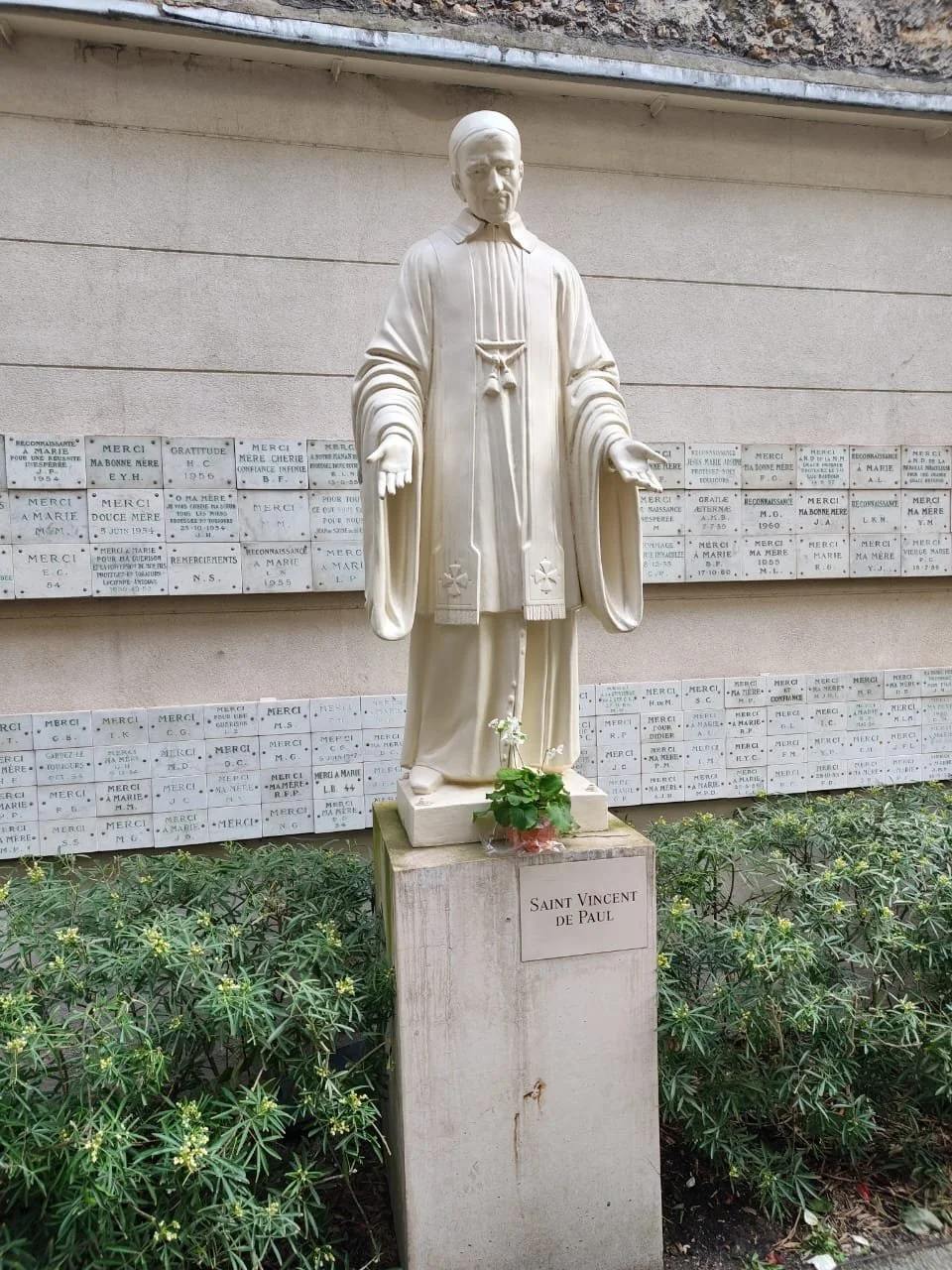
Still in this century, it deserves special highlight, a most grandiose character, one of the greatest icons of charity in the history of the Catholic Church: Saint Vincent de Paul. Known as the “Father of Charity”, he is considered the greatest example of humility and charity of this period.
Father Vincent was born in a small village, Pouy, in the south of France, and since small already demonstrated much intelligence and great religiosity. He became priest still very young, at nineteen years of age. On a certain occasion, he was captured by pirates and sold as slave in the north of Africa, where he remained for two years. He did not revolt himself, however, and did not cease to advise the brothers in captivity about the necessity of having compassion for the oppressor, ending up converting his captor to Christianity.
Father Vincent always concerned himself with the abandoned and forsaken children, with the elderly, the poor and the sick. During all his existence he created great works, always turned to charity, which until today render services to humanity.
Father Vincent had as primordial base of conduct the examples of the Master Jesus, for, as he himself said: “To die with Jesus Christ it is necessary to live as Jesus Christ”.
Father Vincent was one of the illuminated beings that passed through the Earth...