
The Thirteenth Century
The Thirteenth century
SPECIAL FEATURE ON FRANCIS OF ASSISI
We open a special space, within this century, to speak exclusively of this great enlightened one who was a milestone in the History of Christianity. To speak of that one who not only preached the teachings of Jesus, but who lived intensely His Gospel of love like no one: Francis of Assisi, or, as he is known within the Catholic Church, Saint Francis.
He is the living proof that God never left humanity in the open, abandoned, and that the boat of the planet Earth has always been under the command of Jesus.
We were, then, since the 5th century, in the Dark Ages (that would extend until the 15th century), as the historians call this period. And it was in this window of time that Francis arrived to the world!
Traditions say that Jesus called John the Evangelist so that he would return to the stages of the world, in order to restore the Message of the Gospel, which was going forgotten due to many turbulences and of a Church that moved away from the primitive ideals. He would come, therefore, to reestablish a Christianity based on contact, on simplicity, on the proposal of love, of fraternity, on the living and on the principles that Jesus had come to teach.
The most probable is that he was born on the day 26 of September of 1182. The important is that he came and came to give continuity to the message of Jesus.
His mother was called Pica de Bourlemont, a noble woman of French origin. His father was called Pietro di Bernardone, a rich merchant. His mother gave him the name of Giovanni (John) di Pietro (name of the father) di Bernardone (family name).
The first most interesting story of his life occurred on the occasion of his birth, as traditions say. His mother was in labor during the whole night and he did not be born. In the morning, a beggar knocked at the door of the house and, when he was attended by the maid, told that she should say to the lady that the boy would not be born in a rich room, but in the stable of the house, for it would be there that he would come to the world.
She went, even against the will of the father, who said to have a name to care for and that, in the stable, his son would not be born. She answered to the husband that she had passed the whole night in suffering and that she would go down to the stable.
And it was in a stable that Francis was born, in the middle of the animals and of the straw, just like Jesus! He is known, according to the Catholic tradition, as the Other Christ, for having molded his life, poverty and spirituality to the image of Jesus, living an existence based on that of the Master.
Until then, his name was not Francis. There are three the hypotheses for his name to have changed: 1) His father was a rich merchant who sold very expensive fabrics, and the best came from France; therefore, Francesco. 2) In homage to the French origin of his mother, Pica. 3) In adolescence, he liked to frequent taverns, drink wine and be with friends, who called him Little Frenchman.
For the majority of the historians, his name, Francesco, was adopted from the birth. Others affirm that the change occurred later. The most probable is that the alteration occurred because of the fabrics coming from France to the shop of his father. Therefore, his name was changed by the father, passing to be Francesco di Pietro di Bernardone, and not the name that his mother had given him.
His father, being a rich merchant, wanted that the son follow his steps in the businesses, that he be a great knight and fight in the crusades and in the wars between neighboring cities, common in the time, for commercial and economic supremacy, or still that he follow the religious life.
History narrates that Francis became fond of the military life. He wanted, in fact, to be knight. This pleased very much his father. He had a life like any young man, with the same problems, dreams and aspirations. He frequented taverns, gathered with friends and was not different from the others. He enlisted in the army, but never participated in the great crusades, only in the local battles between neighboring cities.
We were in the period of feudalism (small kingdoms with their local lords). The cities had their dependencies, each one with its laws and its own coins, as if they were isolated countries. In this period, Italy was all fragmented and the cities entered in war with each other for diverse interests. Therefore, Italy was a set of city-States, and not a country as it is today.
The first war in which Francis participated was against the city of Perugia, but Assisi was defeated. With this, his life began to change, for he was made prisoner. Historians affirm that he remained about one hundred days imprisoned in isolation. He counted then with approximately nineteen years of age.
In this period in which he was imprisoned, he began to notice the people of the cells at the side. Thin people, worn down, passing hunger and cold. He began to analyze the situation in which all found themselves after having fought for a cause that led them to a depressing condition, without freedom. He began, then, to resignify his purposes of life and began to pray. Historians tell that, when he received the bread, he no longer ate it, but divided it with the companions of cell, initiating also dialogues with them.
After one hundred days, his father paid the bail to free him, for it was common, in the time, that nobles rescued prisoners in this way. He returned to Assisi, but he was no longer the same. His dream of becoming important had faded. He was transformed, although he was still not the Francis that we know today.
Even so, he enlisted again for a new war, this time against the city of Puglia, in the south of Italy. When he entered the city of Spoleto, still far from his destination, his horse reared and he heard a voice that said: “My son, whom do you want to serve, to God or to men?”. Francis then descended from the horse and returned to Assisi.
However, when a son becomes deserter, he is no longer well received, especially by the father, for, with such attitude, he had dishonored the name of the family.
Thus began great frictions with his father, who was pointed as someone who had a deserter son. Francis began to be beaten a lot and to receive severe punishments. His father put him to work hard, wanting that he change. His mother, always at his side, suffered with him.
In this period, Francis entered into a life of prayer and meditation. He began to walk through the meadows and fields of Assisi, conversing with the birds and with the wolves.
There was in the city of Gubbio a ferocious wolf that terrified everyone and that many wanted to kill. Francis asked that they not do it, for he would go to talk with him, and thus he did. He understood that the wolf was hungry and that, for this, it frightened the people. Francis began to take him food, and the animal ceased to terrify the inhabitants, becoming friend of them.
With this, he began to be seen not only as deserter, but also as mad, for he spoke with animals. On a certain occasion, a leper approached him and, for the first time — for previously he did not permit the approach of someone in that condition —, he did not push him away with harsh words. He said to him: “What before seemed to me disgust, now seems to me sweetness. What do you want from me, my brother?”.
The leper was frightened: “Your brother?”.
Francis answered that yes, for both were sons of God. He was transforming himself completely.
On another occasion, he entered in a church almost in ruins, the Church of Saint Damian. While he prayed and looked fixedly to the crucifix that there was, he heard a voice that said to him: “My son, rebuild my Church, which is in ruins”.
It was about the renewal of the Church itself, but, in a first moment, he understood that he should rebuild materially that small church.
He then began to gather stones to restore it, but they were few and he did not have own resources. Historians tell that he began to take fabrics from the shop of the father to sell and buy material for the reconstruction. If it was exactly thus or not, the fact is that his ideal was noble.
After the restoration, he perceived that it was not the material church that he should rebuild, but the Moral Church.
The Catholic Church, in that century, was very distorted by the practices of indulgences, of the crusades, of the sale of pardon and by the Inquisition that was beginning. It was the message of Jesus that needed to be restored: the message of His Gospel.
It was an awakening in his life. He would be a messenger of Christ and would preach the Good News wherever he were.
His proposal was a little different from the other mendicant orders that already existed, such as the Augustinians, the Gregorians and the Dominicans, for Francis wanted to speak less and do more. Still is attributed to him this phrase: “Go, preach the Gospel and, if necessary, use words”. While he cared for the children, the sick and the elderly, he spoke of the Gospel.
His father made, then, a denunciation to the Tribunal of the Holy Office of the time. The bishop was called Guido and liked Francis. For this reason, he heard the accused, something uncommon for the Church, which generally only conceded opportunity so that the person redeem himself.
Thus, in the square of Assisi, around the year of 1206, an ecclesiastical tribunal was instituted, having as accuser Giovanni Pietro di Bernardone, the father, and as accused the son himself, Francesco di Pietro di Bernardone, then with twenty-four years of age.
The denunciation was that Francis, according to his father, was mad. He conversed with animals, took merchandise from the shop to sell and restore a church in ruins and, because of this, the people spoke badly of the family. His father wanted only to recover the son, not to see him condemned. The bishop, then, gave to Francis the opportunity to defend himself.
Francis limited himself to speak of the love that he felt for the father and, looking into his eyes, thanked him for all that he had done for him until that moment. He said still that he would not have how to return the goods that he had taken, for he had used them in the reconstruction of the church, once that he had confused himself regarding the order received. However, what he still possessed, he would return.
Then, he removed all the clothes that he wore and gave them to the father. He said farewell to all and became the Francis that we know...
From now on, he would no longer be Francesco di Pietro di Bernardone. He would be simply Francis of Assisi, the “Troubadour of God”. From then on, he would sing God as the birds sing. Every day he would speak of the Gospel. He became a minstrel of God, as some historians say. It was a profound change in his life. He desired that the people return to the Christianity of the times in which Jesus still walked among us.
In the southern region of Assisi there was a small chapel in Santa Maria degli Angeli, in the curve of the Rivo Torto (“crooked river”), so called because the river made a curve exactly where the chapel was located. Francis used it to begin his work of spreading the Gospel, caring for the needy and speaking of Jesus. He gave it the name of Porziuncola, which means “small portion”.
It was a very small chapel, of extreme simplicity, where barely fit some people. Between the 16th and 17th centuries was built a huge basilica over the Porziuncola, to protect it.
Already to the north of Assisi, later, was built a sumptuous cathedral, composed of three churches built one over the other, literally, and that received the name of Basilica of Saint Francis.
“With all respect, it does not approach the Franciscan ideals, for it is much more a construction of the Church.”
In one of these churches, that of the underground, are found the remains of Francis and of his closest friends. His coffin, very small, is entirely made of stone, for thus he desired: in simplicity.
Unfortunately, in this church photographs are not permitted, but what is felt there inside is indescribable...
Francis of Assisi was not a revolutionary in the common sense of the word. He did not want to break with the Church; all the Franciscan revolution happens in the soul. So much so that he had the initiative to seek pope Innocent III to deal with him.
While he lived in the surroundings of Santa Maria degli Angeli, other people began to join Francis and to share the Franciscan ideals.
Twelve were his first companions. The first was Bernard of Quintavalle. He was a knight, like Francis, who abandoned the armor. The four closest and his confidants, who are buried with him, are: Friar Rufino, Friar Angelo, Friar Masseo and Friar Leo.
Francis and his companions went from Assisi to Rome, walking, to find pope Innocent III.
It is remembered that this pope was one of the most severe that the Catholic Church had, for during his pontificate occurred the Albigensian Crusade, in which thousands of people died in the south of France. However, he also carried out important works within the Church. Even so, Innocent did not want to receive Francis.
They stayed, then, there, waiting that the pope change of idea. By intervention of a cardinal called John of Saint Paul, who ended up convincing Innocent to reconsider, arguing that perhaps it would be prudent to receive that young man and his group, for he could be helping to restore the foundations of the Church.
Innocent slept and had a symbolic dream involving the mother of the churches, the Basilica of Lateran (San Giovanni in Laterano), dedicated to Saint John the Evangelist and Saint John the Baptist.
In this dream, he saw a young man sustaining one of the columns of the Church, and this young man was Francis.
He awoke impressed and, on the next day, ordered to call him.
Francis answered to the pope that he desired to live like Jesus and recited the Gospel of Matthew, chapter VI, verses 25 to 34.
The pope said to him that he also had had this ideal in youth: to build a Church without status, without money and without power, in the most pure simplicity. However, he believed that this was impossible.
In this moment, the cardinal John of Saint Paul observed that, if that were impossible, then to live the Gospel also would be impossible.
The pope reflected on these words and ended up allowing that Francis live according to the teachings of Jesus.
They returned to Assisi and began to preach. In that time, to be preacher, it was necessary the consent of the pope.
Francis established three rules for those who wished to enter the order: poverty, obedience and chastity.
Further ahead, there arose three Franciscan branches: the Friars Minor, whose members did not possess material goods and lived under the vow of chastity; the Poor Clares, formed exclusively by women; and the Third Order, or secular, whose members could follow the Franciscan spirituality without abandoning the family life.
Thus, the Franciscan Order grew rapidly throughout Europe. The magnetism of Francis was impressive. He employed so much conviction, intensity and authority in what he spoke and did, that he contributed decisively to the expansion of the order through the world.
Francis presented a proposal totally contrary to what one could imagine. His presence of spirit, his magnanimous character and his illuminated aura were some of the reasons of the success of the order that he founded.
Today, who visits the places where he lived still can feel his magnetism and his spiritual presence...
It is told that, at the end of his life, pope Innocent III contracted leprosy and was placed in an isolated room. He no longer exercised the command as before and there was no one who wanted to take care of him. Francis went to visit him and, seeing him almost all deformed by the disease, assisted him until his last days.
Francis met the Offreducci family and one of the daughters, the young Chiara (Clara). When she heard Francis speak, she became deeply enchanted with him. The two lived an intense love, but a love of soul. Clara desired to follow him, however there was no space for women in the Franciscan Order. With the help of Francis, she founded the Order of the Poor Clares. Her sisters and her mother ended up entering also in the religious life at her side.
Francis visited Clara whenever possible. They conversed, exchanged ideas and spoke about the difficulties of the spiritual path. They became known as the Brother Sun and the Sister Moon.
In 1219, Francis decided to join a crusade, not to war, but to dialogue with the sultan Al-Malik al-Kamil, nephew of the celebrated Saladin (Salah ad-Din). The intention of that crusade was to conquer Egypt, which dominated Palestine and, thus, retake the Holy Land.
Francis exposed his purpose to the cardinals, who advised him to desist, affirming that he would end up killed. Even so, he decided to go forward.
Historians tell that, when he approached the camp of the sultan, warriors came to his encounter with spears, disposed to kill him. However, Al-Malik left his tent and prevented the action, for he had dreamed with that man and allowed that he enter.
In the dialogue that followed, Francis explained that he came in name of peace to present Jesus to the sultan.
— Which Jesus? — asked Al-Malik. — The Jesus that kills? The Jesus that transformed Jerusalem into a pool of blood? The Jesus of the knights who burn cities and throw salt on the land so that nothing more grows?
— No! — answered Francis. — I came to present to you the Jesus of the Beatitudes; the Jesus that transfigured on Tabor; the Jesus that was crucified between two thieves; the Jesus that is the Prince of Peace. The sultan answered that this Jesus he did not know and asked that Francis speak more about Him.
After, for his part, Al-Malik spoke about the prophet Muhammad, about the Quran and its suras, and Francis listened to him with respect.
Together they elaborated a plan of peace that, unfortunately, was never concretized, although it was sincerely attempted by Francis in that year of 1219.
The sultan granted him safe-conduct to circulate freely through his domains. Francis returned and sought the cardinals to present to them the plan of peace, but he was not heard.
Deeply saddened, he decided to walk through the Holy Land to know the places where his Master had lived. After, he returned to Assisi.
Perhaps in reason of the sand of the desert that constantly struck his eyes, he developed trachoma in both. There was no cure for this illness. The treatment consisted in cauterizing the eyes to prevent that the infection spread.
Francis even came to compose a poem for the fire that would be used in this procedure:
“O brother fire, you who illuminate, bring beauty and lighten the paths, need now to burn me. I know that I am sick, but, when you burn me, do it with softness, so that I do not feel so much pain. Only fulfill your mission.”
He had the eyes cauterized and remained faithful to Jesus.
Before, however, of losing the vision, when he still returned to Italy, he passed through the city of Greccio, in the province of Rieti. Inspired by the visit that he had made to the Holy Land and wishing to remember the birth of Jesus, he created the first nativity scene of History, using real people and animals, in the year of 1223.
The nativity scene was mounted at the top of a hill and could be seen by all the inhabitants of the region.
Still today it is possible to visit that place that, according to many pilgrims, seems to conserve something of the spiritual magnetism of Francis.
When he finally returned to Assisi, he felt himself deeply disappointed. Friar Elias, who administered the Order in his absence, had modified one of the original rules. From now on, it would be permitted to possess money and occupy positions of prestige.
Francis was extremely saddened.
In 1224, he went up to Mount Alverne, in the proximities of Assisi. There, in prayer, he asked Jesus where he had erred, if he had truly followed each line of the Gospel.
While he prayed, he received the wounds of Christ, phenomenon known as stigmatization: the marks of the nails in the hands and in the feet.
He then heard an interior response: it was up to him only to fulfill the part that was his; he was not responsible for the choices of the others.
Sister Clara also told him that it would even be a form of pride to want to assume responsibility for the acts of others. The important was to fulfill faithfully his own mission.
The final hour then arrived.
On 3 of October of 1226, he called Clara and Friar Leo and asked them to take him to the Porziuncola, for it was there that he wished to die.
He asked that they remove his clothes and place him directly on the ground, for he wanted to return to the true life in the same simple way as he had chosen to live.
And thus, blind, thin, weakened and with serious health problems resulting from the deprivations that he had endured during life, he departed from this world.
Tradition tells that, at the moment of his death, the birds of Alviano, with which he used to converse, came to his encounter and began to sing.
The Church celebrates Saint Francis on the day 4 of October of 1226, date of his burial. However, the date of his death was 3 of October.
The cardinal Ugolino became later pope Gregory IX. In 1228, he canonized Francis, making him officially Saint Francis of Assisi, patron of Nature and one of the patrons of Italy.
When Jorge Mario Bergoglio, in Buenos Aires, chose the name Francis for his pontificate, he brought with him, in a certain way, all the symbolic and spiritual force associated to the saint of Assisi.
In the same way, the current pope Leo XIV evokes, by the chosen name, the historical memory of Friar Leo, one of the closest companions of Francis.
FRANCIS OF ASSISI, GUIDE OF HUMANITY!
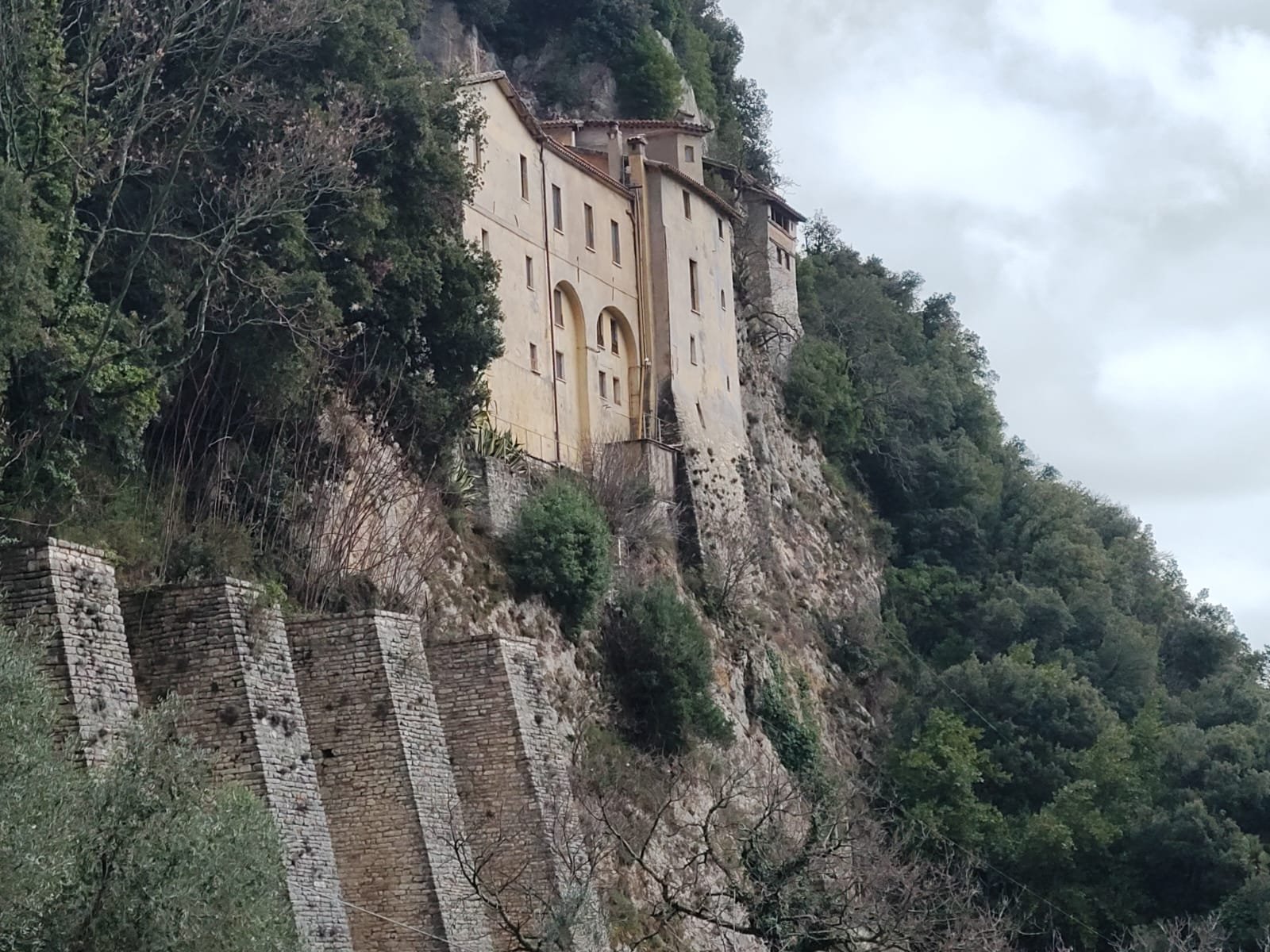
Th place were Francis created the first Nativity scene
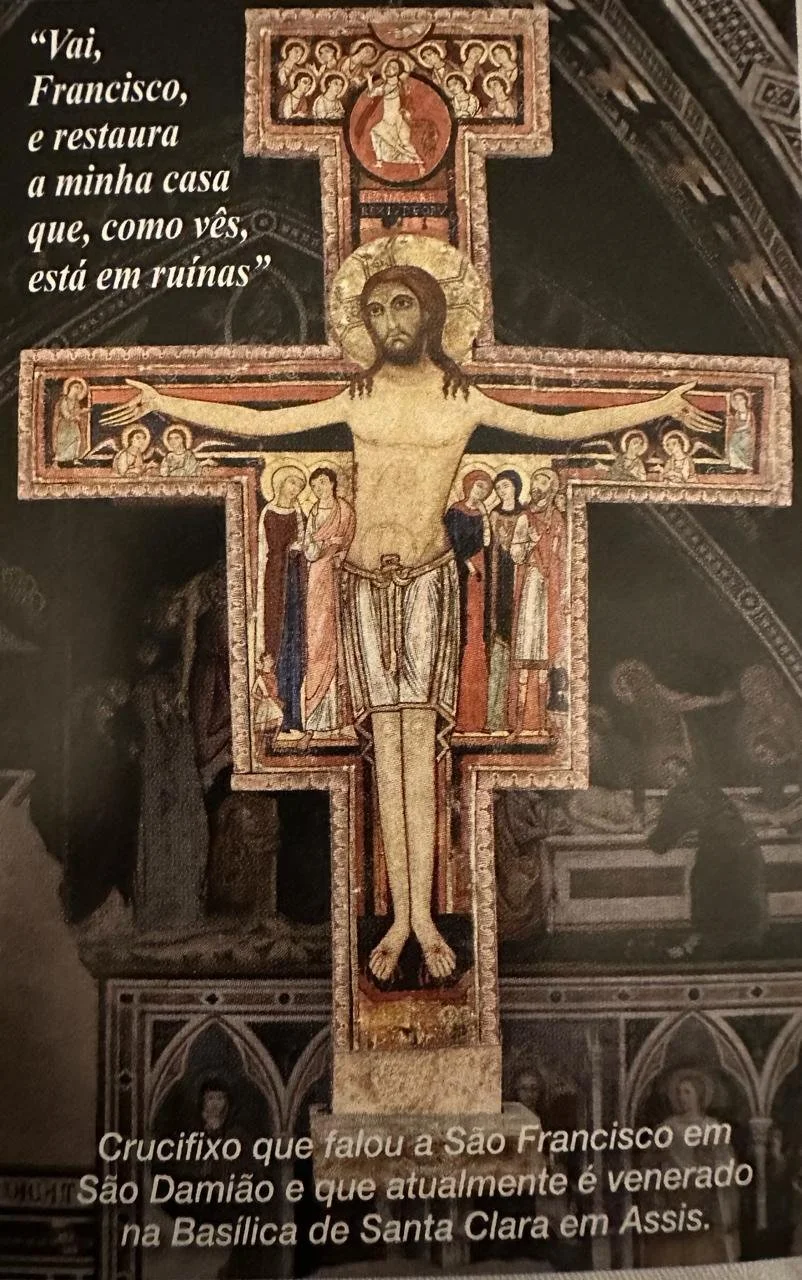
The crucifix that spoke to Francis
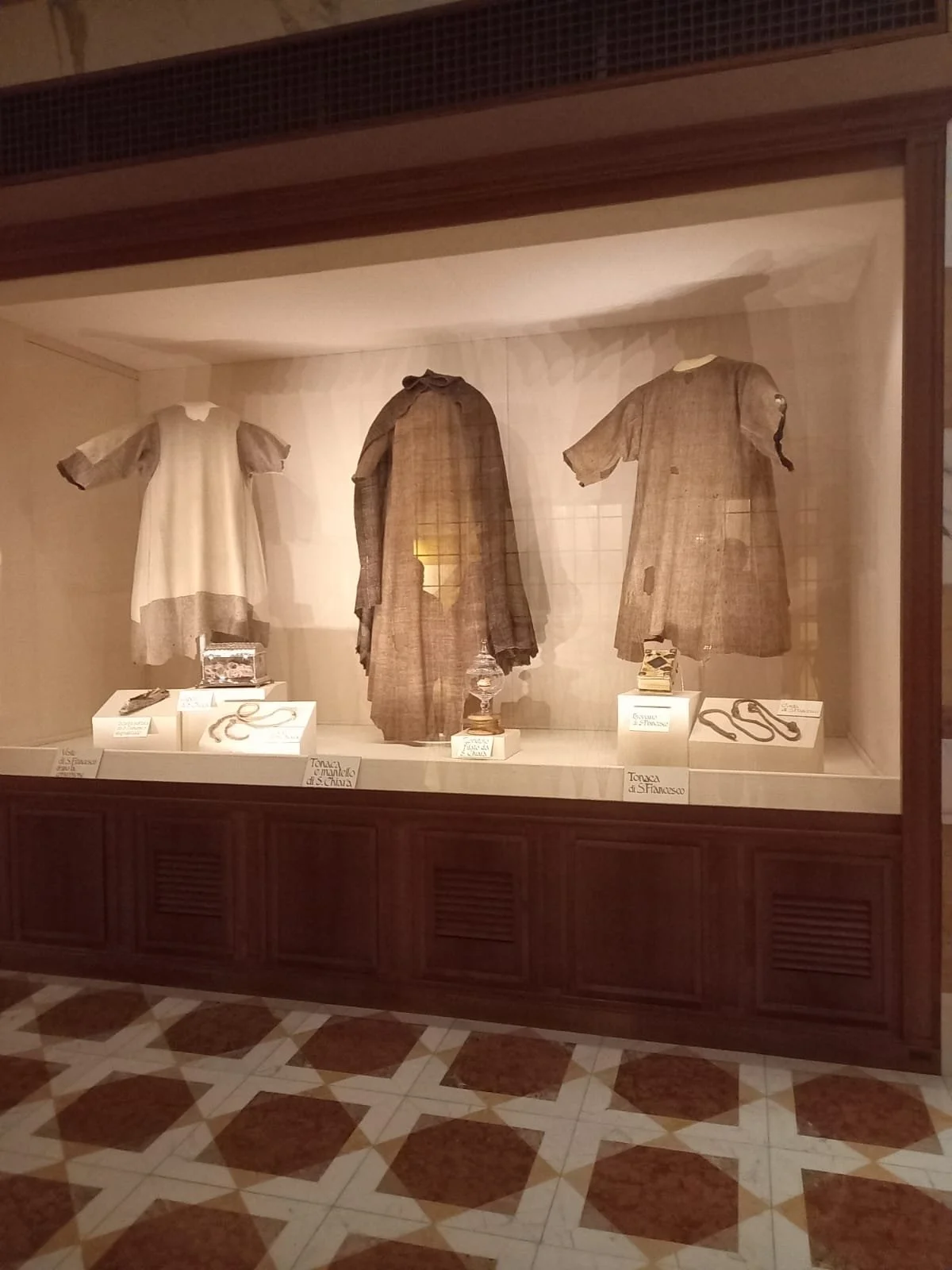
The Garments of Francis and Clare
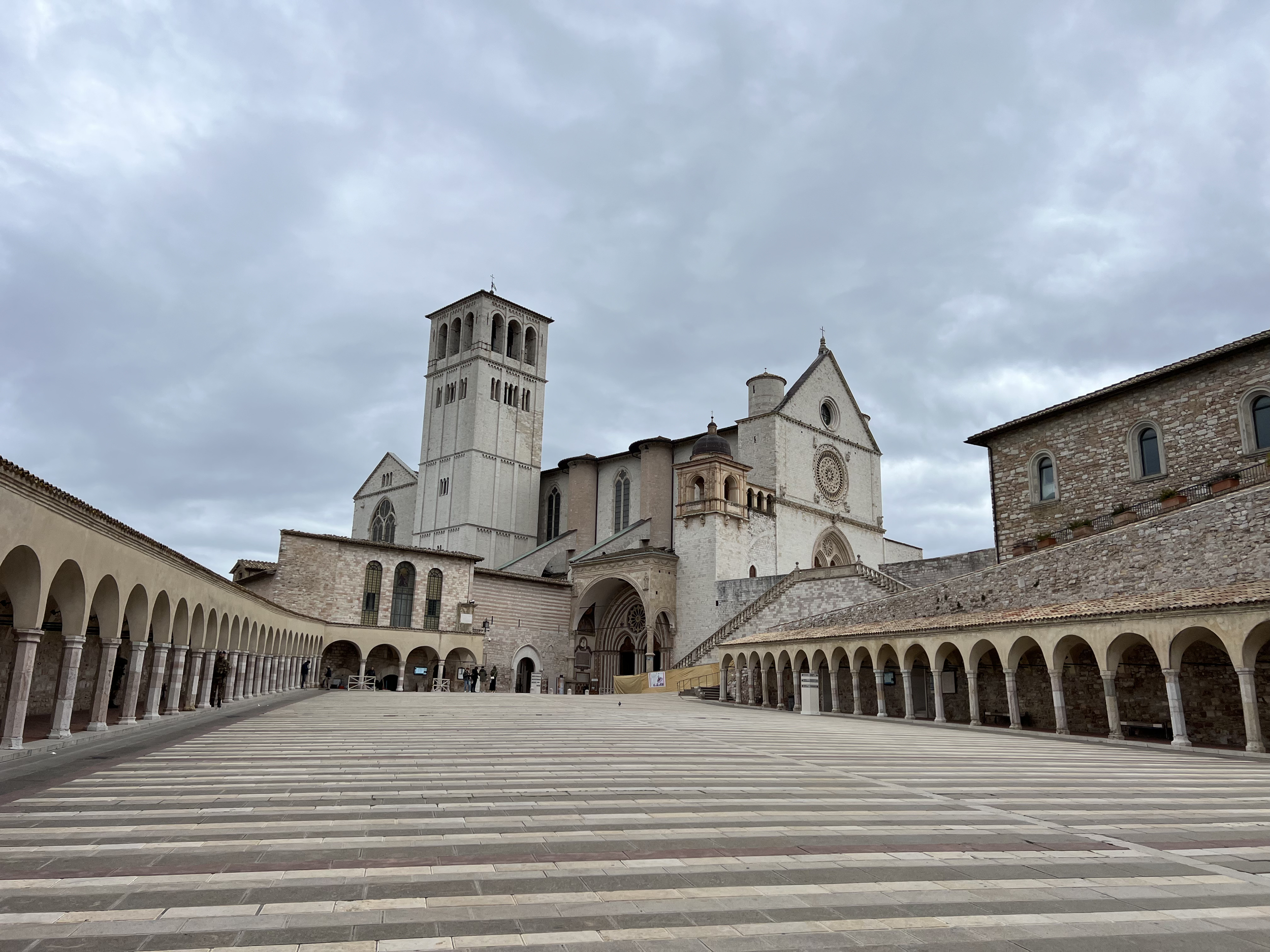
The three churches built on top of another
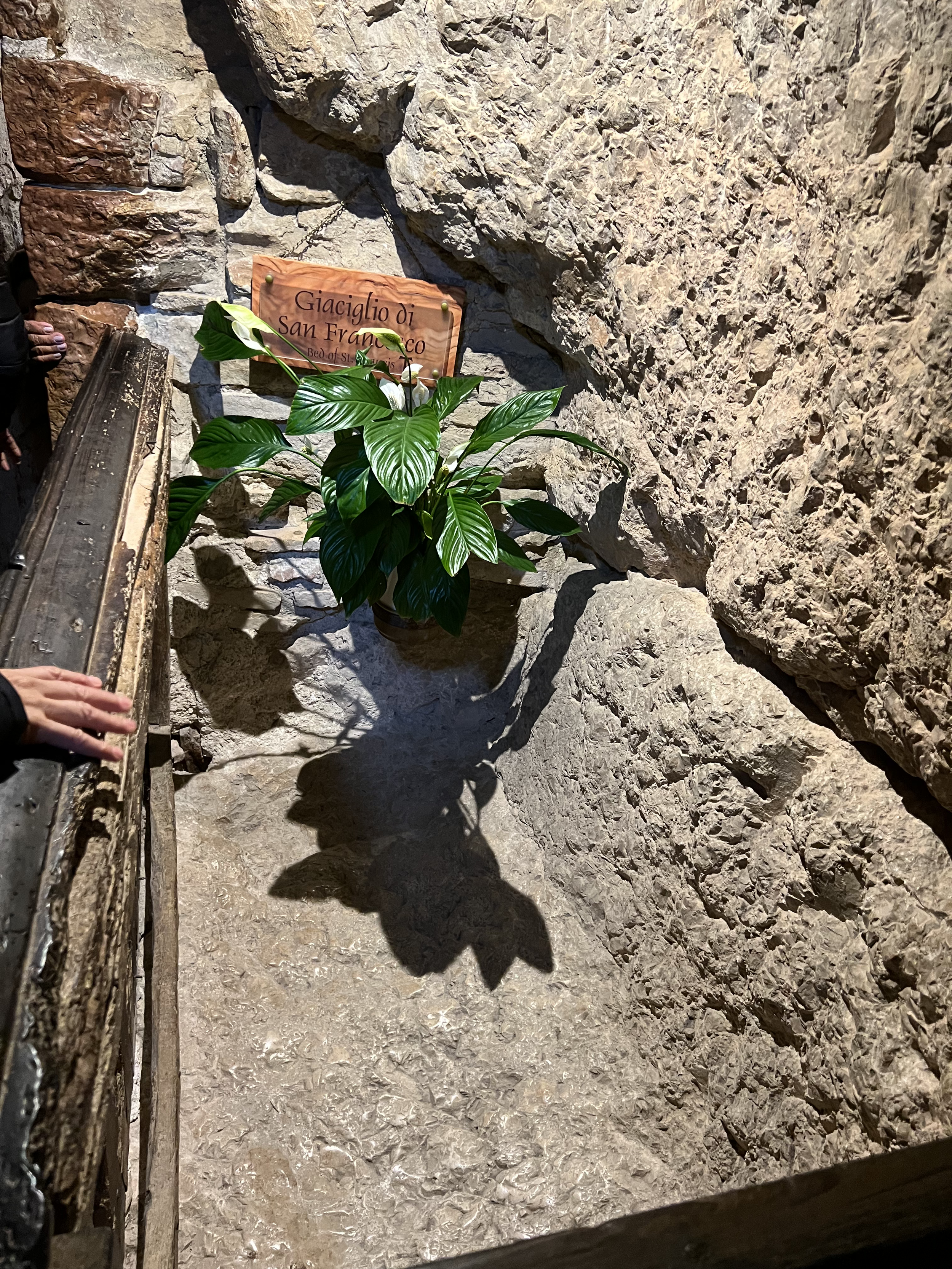
The bed were Francisco slept
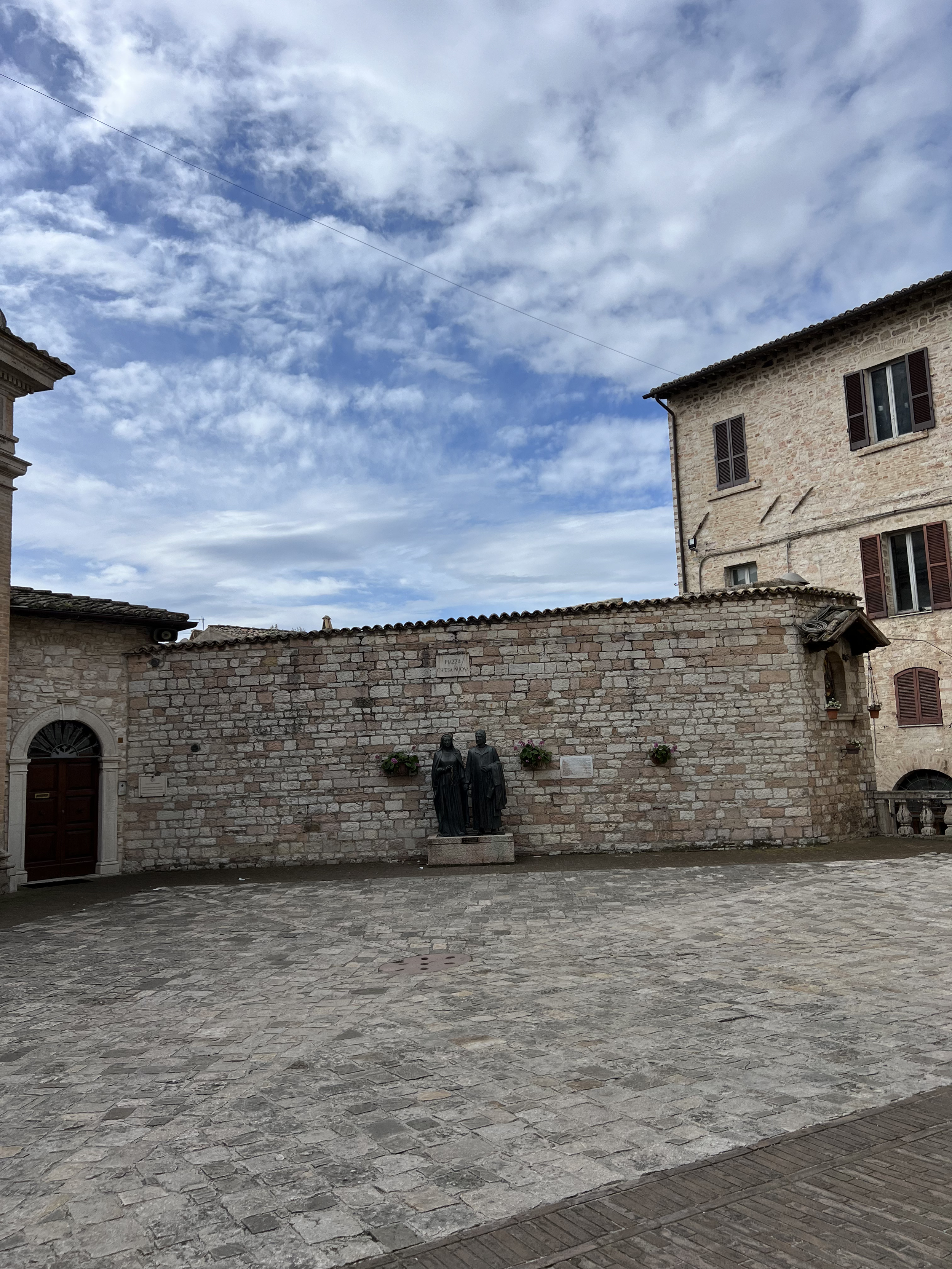
The Bernardone family residence